
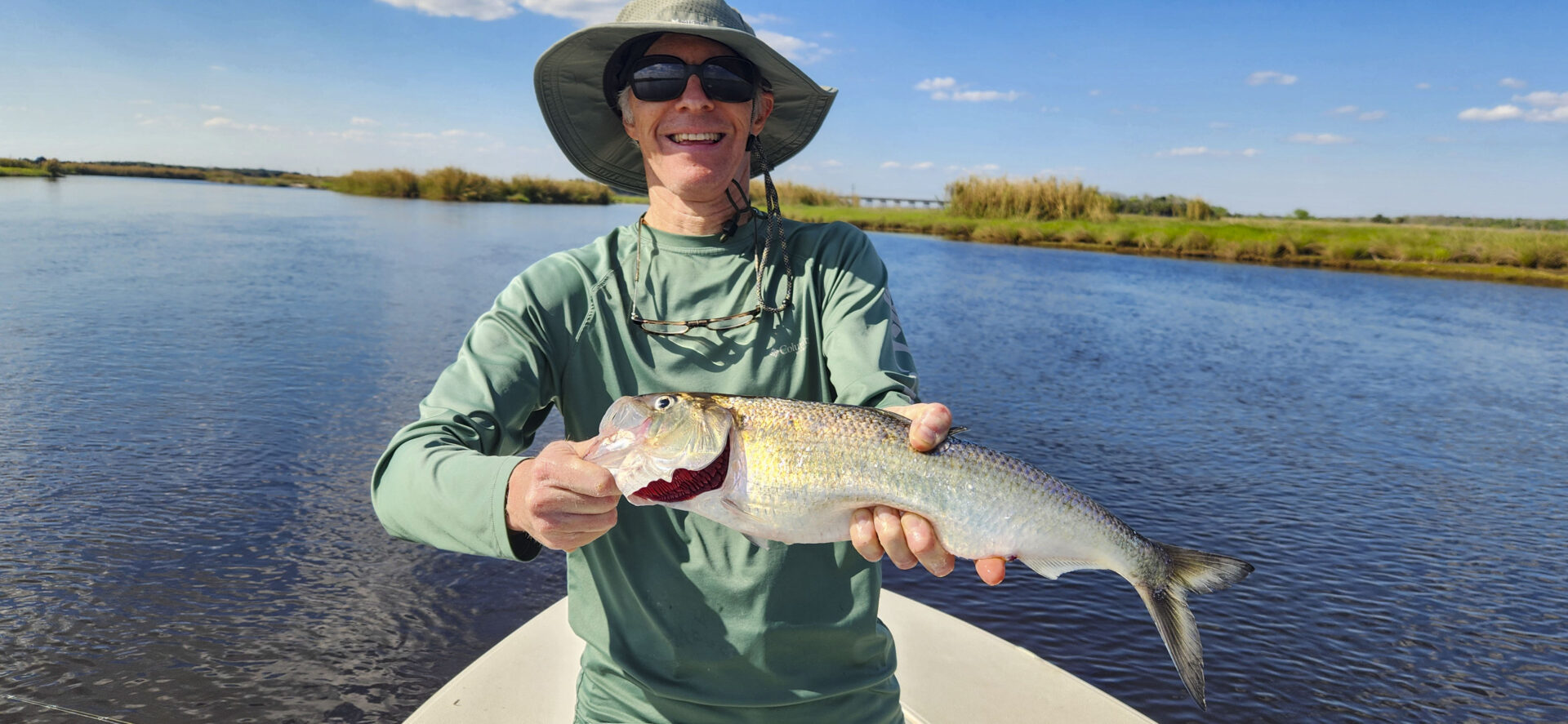
American Shad Fishing in Central Florida
American shad offer one of the most overlooked and accessible freshwater fishing opportunities in Central Florida. Each year, these anadromous fish migrate up large river systems from the Atlantic, providing fast-paced action for anglers willing to fish moving water. While often associated with northern rivers, the St. Johns River in Florida, specifically the section in Central Florida just east of Sanford and Orlando supports a reliable shad run that is well suited to light tackle and fly fishing.
Seasonal Shad Runs on the St. Johns River
In Central Florida, American shad typically begin appearing in late December, with the peak of the run occurring from January and February, sometime into March. They move upriver to spawn, concentrating in deeper bends, current seams, or other areas with sufficient current flow. Each year is a little different. Some years can results in average catches of 20 plus fish per trip, others can be hit or miss. Unlike many Florida fisheries that require long runs or specialized boats, shad fishing often happens close to access points and does not demand advanced local knowledge to be productive. It is easy for beginners and still fun for veteran anglers
How American Shad Look and Why They Fight So Hard
American shad are bright, silvery fish with streamlined bodies, dark eyes, and a forked tail built for sustained swimming. Their appearance and behavior are often compared to small tarpon, especially when hooked. They jump, roll, flash, and surge in strong currents, using the flow to their advantage. Despite these similarities, shad are not related to tarpon. Shad belong to the herring family, while tarpon are part of a completely different lineage. The resemblance is superficial, but the fight is very real. Shad are also generally much easier to hook and land than tarpon and are far more aggressive feeders.
Ultralight Spinning Tackle
Spinning tackle is the most common approach when fishing for shad on the St. John’s River in Central Florida and works extremely well for beginners. Ultralight rods in the 6- to 7-foot range allow anglers to cast small lures while still providing enough control in current. Light spinning reels spooled with thin monofilament or braid help achieve long drifts and maintain sensitivity.
Small spoons, darts, and jigs are traditional shad offerings. These lures imitate small baitfish and can be worked across current seams or allowed to swing naturally downstream. The key is keeping the lure moving with the flow while maintaining occasional contact and vibration. Because shad often strike aggressively, even first-time anglers quickly recognize when a fish is hooked.
Fly Fishing with 3- to 5-Weight Fly Rods
Fly fishing for American shad is both effective and highly enjoyable. Rods in the 3- to 5-weight range are ideal, offering enough backbone to manage strong fish while preserving the sport of the fight. Floating or intermediate lines are commonly used, depending on current speed and depth.
Simple streamer patterns, small baitfish imitations, and brightly colored shad flies work well. Presentation is more important than pattern complexity. Flies are typically swung across current or lightly stripped as they drift downstream. Shad readily take flies on the swing, often resulting in sudden, powerful grabs that surprise anglers new to the species. Unlike much of the saltwater fly fishing opportunities in this region, the casting skills needed for shad fishing can often be learned in a few minutes with the roll cast being the easiest.
Where to Fish: Boat, Kayak, Canoe, or Bank
One of the major advantages of shad fishing in Central Florida is easy access. Anglers can fish effectively from small boats, canoes, kayaks, or directly from the bank. Many productive stretches of river feature public access points, bridges, and shoreline areas where current concentrates fish. Mullet Lake Park, CS Lee park, and the Highway 50 Boat Ramp being the most popular.
Kayaks and canoes allow anglers to quietly position themselves along current breaks, while boats provide mobility to cover multiple areas in a single outing. Bank fishing remains extremely productive and is often where beginners find early success, especially near obvious flow changes or deeper channels.
A Mixed Bag of Species Adds to the Fun
Shad are rarely the only fish caught during the run. Anglers frequently encounter a wide variety of panfish such as bluegill, redbreast, shellcracker and more, along with speckled perch and largemouth bass. This mixed-species potential keeps the action steady and adds variety to every trip. Light tackle makes even smaller fish enjoyable, reinforcing why this fishery is so well suited to casual outings and family trips.
An Ideal Fishery for Beginners
American shad fishing is straightforward, affordable, and forgiving. The techniques are simple, the gear is light, and the fish are aggressive. Beginners do not need advanced casting skills or expensive equipment to be successful. The combination of accessible locations, frequent bites, and hard-fighting fish makes shad an excellent introduction to both spinning and fly fishing in moving water.
For anglers looking to experience something different from typical Florida freshwater fishing, American shad deliver excitement, variety, and a surprising connection to big-fish behavior in a compact, approachable package.
Capt Chris Myers offers light tackle and fly fishing charters for shad near Orlando He can be reached at 321-229-2848